The Amazon Is Not Empty Wilderness. It Is Home.
Meet the living cultures, river nations, forest guardians, and ancestral knowledge systems of the Colombian Amazon.The Colombian Amazon is one of the most biodiverse regions on Earth — and one of the most culturally rich. Across rivers, forests, foothills, and borderlands, Indigenous peoples have cared for this territory through languages, ceremonies, gardens, medicine, oral traditions, and systems of community governance.
Dulce Amazónica exists to help visitors understand a deeper truth: the Amazon is not a backdrop for tourism. It is homeland, memory, responsibility, and living civilization.
Respect Comes Before Curiosity
Dulce Amazónica does not present Indigenous peoples as tourist attractions. Cultural knowledge belongs to living communities, elders, families, and authorities. Any sharing must be based on consent, dignity, fair trade, and direct community benefit.
Some peoples, including communities in voluntary isolation, must never be contacted or visited. Their right to remain uncontacted is a right to life.
Explore the Colombian Amazon by Region
Six distinct territories. Each with its own peoples, rivers, languages, and living knowledge systems.
Amazon River Basin & Tri-Border Region
Where the Amazon River meets the Colombian, Peruvian, and Brazilian borders — home to some of the oldest continuous cultures in the hemisphere.
Tikuna, Yagua, Cocama, Bora, Muinane, Okaina
Putumayo, Caquetá & Rubber-Boom Memory
Territories shaped by the catastrophic violence of the rubber era — and by extraordinary cultural survival through ceremony, language, and territorial resistance.
Huitoto, Andoque, Miraña, Nonuya, Siona, Coreguaje
Vaupés, Pirá Paraná & Eastern Tukanoan World
One of the most complex multilingual cultural systems on Earth. More than a dozen intermarrying peoples, each speaking a distinct language, living along river networks deep in the Colombian Amazon.
Tukano, Desano, Cubeo, Barasana, Bará, Tuyuca, and 12 more
Guainía & the Amazon-Orinoco Region
Where the Amazon watershed meets the Orinoco system — border territories home to peoples with deep connections across both great river systems.
Curripaco, Puinave, Piapoco, Sikuani, Achagua, Kakua
Andean-Amazon Foothills
Where the Andes descend into the Amazon — bridging highland and lowland knowledge systems, where Indigenous peoples manage altitude, cloud forest, and tropical rainforest at once.
Cofán (A'i Cofán), Inga
Nomadic, Semi-Nomadic & Isolated Peoples
Peoples who live beyond settled territory — in voluntary isolation, in mobile forest lives, or in the borderlands between the known and unknowable. Their existence is a right, not a curiosity.
Nukak, Jiw, Yuri & Passé (voluntary isolation)
The Peoples We Work With
Indigenous nations across the Colombian Amazon — each with distinct language, territory, and living knowledge systems.
Tikuna / Ticuna
Amazon River Basin · Amazonas
One of the largest Amazonian peoples — ceremony, bark-cloth painting, and the coming-of-age Pelazón ritual.
Yagua
Amazon River Basin · Amazonas
Known for extraordinary ceremonial fiber attire and deep river-fishing knowledge across the Colombian-Peruvian Amazon.
Cocama / Kokama
Amazon River Basin · Amazonas
A river people of the Colombian-Peruvian Amazon whose culture survived colonial contact through adaptive resilience.
Bora
Amazon River Basin · Amazonas
Known for intricate bark-cloth art and the mambeadero — the ritual coca-and-dialogue space at the heart of community life.
Muinane
Amazon River Basin · Amazonas
Closely related to the Bora; masters of language-based ceremonial philosophy and botanical knowledge of the mambeadero.
Okaina / Ocaina
Amazon River Basin · Amazonas
Guardians of oral tradition, ritual song, and forest-botanical knowledge along the tri-border Amazon.
Huitoto / Witoto
Putumayo & Caquetá · Survivors of the Rubber Boom
One of the most culturally significant peoples of the Colombian Amazon — survivors of the rubber genocide, bearers of coca ceremony and cosmic memory.
Andoque
Putumayo & Caquetá
Survived near-extinction during the rubber boom; now guardians of ceremonial chant, cosmic knowledge, and territorial memory.
Miraña
Putumayo & Caquetá
River navigators and ceremonial knowledge-holders of the Caquetá with complex social structures and long-distance trade traditions.
Nonuya
Putumayo & Caquetá
Nearly extinguished by the rubber boom — now in active revitalization of language, ceremony, and territorial identity.
Siona
Putumayo & Caquetá
Upriver Putumayo people with deep traditions in ayahuasca ceremony, jaguar shamanism, and sacred river knowledge.
Coreguaje
Putumayo & Caquetá
A Tukanoan-speaking people of the lower Caquetá; holders of traditional healing, river farming, and ceremonial practice.
Cofán / A'i Cofán
Andean-Amazon Foothills · Nariño
Guardians of extraordinary botanical knowledge in the cloud-forest corridor — one of the most biodiverse territories on Earth.
Inga
Andean-Amazon Foothills · Putumayo
Quechua-speaking holders of highland-jungle medicinal plant knowledge, market traditions, and migration-route memory.
Tukano / Tucano
Vaupés & Pirá Paraná
The most widely known Tukanoan people — ceremonial longhouse culture, ceremonial music, and complex exogamic kinship systems.
Desano / Desana
Vaupés & Pirá Paraná
Known as the People of the Universe — interpreting the Amazon through sophisticated cosmological thought and celestial astronomy.
Cubeo / Kubeo
Vaupés & Pirá Paraná
One of the largest Tukanoan peoples of the Vaupés; known for elaborate ceremonial cycles and rich oral traditions.
Makuna / Macuna
Vaupés & Pirá Paraná
Guardians of the sacred Yuruparí territory — deep ritual specialists of the anaconda and water-spirit ceremonial complex.
Barasana
Vaupés & Pirá Paraná
Known for elaborate fruit-harvest ceremonies and Yuruparí ritual — one of the most studied peoples of the Northwest Amazon.
Bará
Vaupés & Pirá Paraná
A Tukanoan people of the Papurí and Tiquié rivers — masters of ceremonial music, mythic narrative, and ecological knowledge.
Tatuyo
Vaupés & Pirá Paraná
Master craftspeople of traditional ceremonial regalia; holders of detailed oral traditions of the northwest Amazon.
Tuyuca / Tuyuka
Vaupés & Pirá Paraná
Celebrated for elaborate ceramic decoration and linguistic complexity — a small but culturally distinct Tukanoan people.
Carapana
Vaupés & Pirá Paraná
Pirá Paraná people with deep ceremonial knowledge and sophisticated longhouse governance systems.
Siriano / Siriana
Vaupés & Pirá Paraná
Known for basket-weaving expertise and ceremonial identity within the broader Tukanoan cultural complex.
Wanano / Kotiria
Vaupés & Pirá Paraná
River people of the Vaupés known for ceremonial life, fish weir knowledge, and traditional governance.
Yurutí
Vaupés & Pirá Paraná
A smaller Tukanoan people of the Vaupés with distinct language and ceremonial traditions within the Pirá Paraná world.
Yukuna
Vaupés & Pirá Paraná
Known for elaborate ceremonial masks and the Kai Ya Ríte ritual cycle — one of the most visually distinctive art traditions in the Colombian Amazon.
Matapí
Vaupés & Pirá Paraná
Guardians of specialized plant knowledge and ceremonial chant along the Mirití-Paraná river.
Letuama
Vaupés & Pirá Paraná
Of the Mirití-Paraná system — closely linked to Yukuna ceremonial life and deep forest management knowledge.
Tanimuka
Vaupés & Pirá Paraná
Deep ritual specialists of the lower Mirití-Paraná; holders of sacred ecological knowledge tied to specific territories.
Wacara
Vaupés & Pirá Paraná
People of the Mirití-Paraná with connections across multiple Tukanoan and Arawakan communities and ecological zones.
Pirarapuya
Vaupés & Pirá Paraná
A Tukanoan people of the Vaupés known for ceremonial practice and close cultural ties with the Tukano and Desano peoples.
Curripaco / Kurripako
Guainía & Amazon-Orinoco · Colombia-Venezuela-Brazil
An Arawakan-speaking people straddling three borders — guardians of extensive trade networks and ceremonial knowledge.
Puinave
Guainía & Amazon-Orinoco
Holders of distinct language and culture in the Guainía; known for weaving, river trade, and spiritual practices distinct from neighboring Tukanoan peoples.
Piapoco
Guainía & Amazon-Orinoco
Arawakan river people of the Guainía and Vichada — known for hammock-weaving, river fishing, and ceremonial knowledge.
Sikuani
Guainía & Amazon-Orinoco · Orinoco Border
One of the largest Indigenous peoples of the Colombia-Orinoco border; known for the Rezo del Pescado ceremony and plant knowledge.
Achagua
Guainía & Amazon-Orinoco
Once widely dispersed across the Colombian Llanos — a small, resilient community now working to revitalize language and territory.
Kakua
Guainía & Amazon-Orinoco
One of the least-contacted hunting-gathering peoples of the Amazon-Orinoco borderlands; territory strictly protected.
Nukak
Nomadic & Isolated Peoples · Guaviare
The last nomadic hunter-gatherers to make peaceful contact in Colombia (1988) — navigating sedentarization while maintaining forest knowledge.
Jiw
Nomadic & Isolated Peoples · Meta
Semi-nomadic forest people of the Meta and Guaviare rivers — displaced by decades of conflict, now in a process of territorial recovery.
Yuri & Passé
Nomadic & Isolated Peoples · Voluntary Isolation
Confirmed voluntary isolation in the Colombia-Brazil-Peru border region. Their right to remain uncontacted is absolute.
Living Knowledge Systems
The Colombian Amazon is a library. These are some of its chapters.
The Chagra
The Amazonian multi-layered garden — not a farm but a managed forest that feeds, heals, and structures social life across generations.
The Maloca
The communal longhouse: gathering space, ceremonial center, and living embodiment of Indigenous cosmology and social order.
Rivers as Living Highways
For Amazonian peoples, rivers are not barriers but roads, territories, and living entities with names, spirits, and governance.
Amazonian Food Knowledge
Manioc cultivation, river protein systems, forest fruits, and fermentation traditions that feed entire river systems.
Medicinal Plant Knowledge
Forest pharmacology held by elders and plant specialists — one of the most sophisticated botanical knowledge systems on Earth.
Languages of the Forest
The Colombian Amazon holds more than 50 distinct Indigenous languages — each one a unique system of knowing the world.
Rubber Boom & Survival
The 1880–1930 rubber genocide: one of the worst atrocities in Amazonian history. Understanding it is essential to understanding the communities that survived.
Voluntary Isolation
Some peoples choose to remain uncontacted. Their right to isolation is a right to life — not a curiosity for outsiders.
From Learning to Human Connection
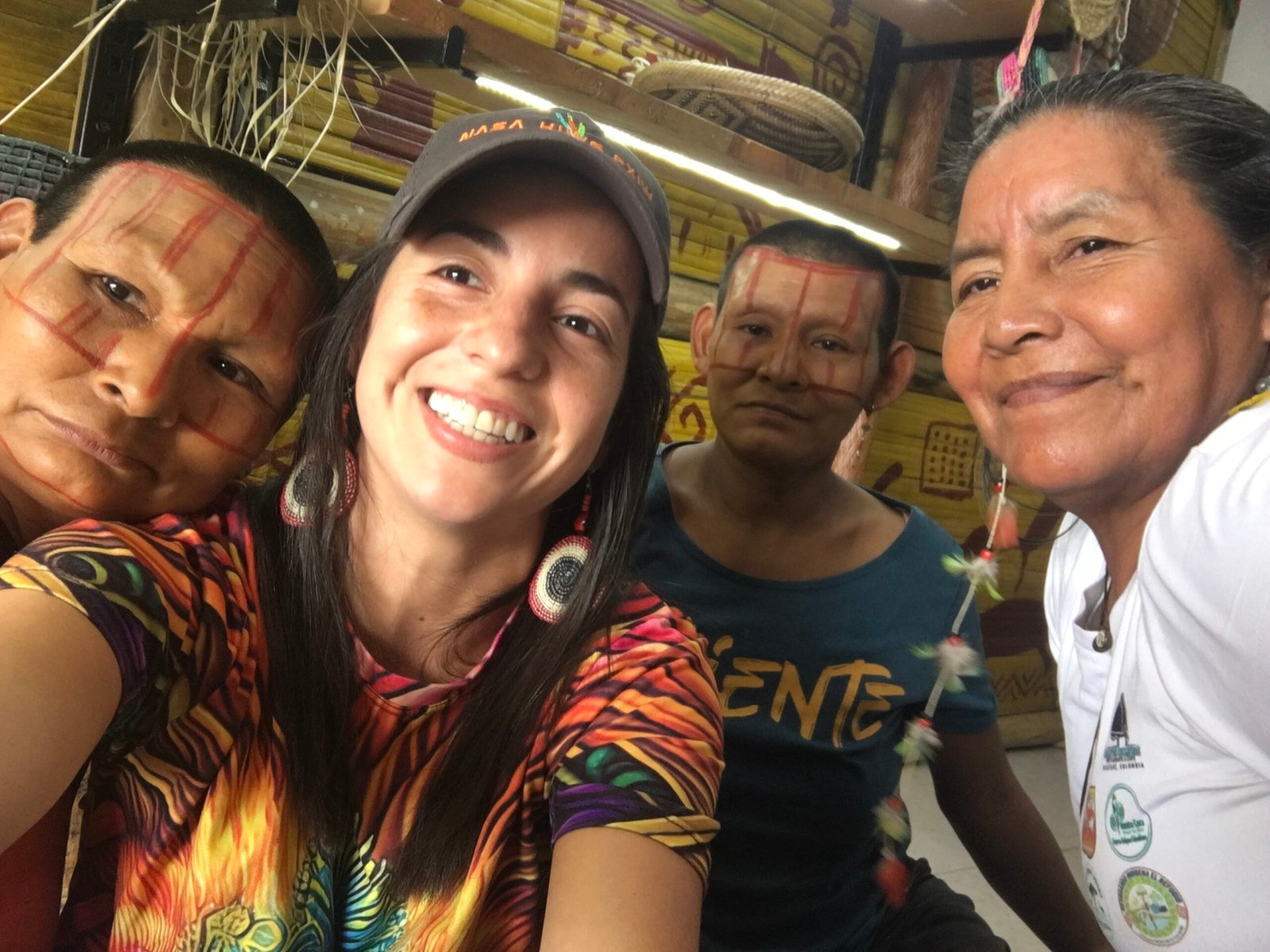
Some Indigenous ambassadors visit Dulce Amazónica through our Embassy model. When ambassadors are present, visitors may have the opportunity to learn directly from them, purchase their artisan work, and support dignified fair-trade exchange.
Dulce Amazónica does not stage culture or pressure communities to perform. We believe cultural sharing must be invited, consent-based, respectful, and beneficial to the people who choose to share.
No Staged Culture. No Poverty Theater. No Handouts.
Dulce Amazónica does not use Indigenous identity as entertainment. We do not promote staged ceremonies, poverty imagery, or rescue narratives. We believe in fair trade, direct benefit, community dignity, ancestral wisdom, and the right of communities to decide what they share.
When people want to help, we ask them to respect community work: purchase artisan pieces, Amazonian foods, and botanical products through fair exchange. Dignity is not charity. Dignity is respect.
Corrections and Respect
Indigenous names, spellings, territories, and histories are complex and may be represented differently by different communities, elders, and institutions. Dulce Amazónica offers these pages as respectful public introductions, not final authority.
If a community representative, elder, researcher, or knowledgeable source sees something that should be corrected, we welcome respectful updates.
Visit the Embassy of the Colombian Amazon in Guatapé
Come taste Amazonian fruit traditions, discover fair-trade artisan work, and learn why the Amazon is not empty wilderness. It is home, memory, living knowledge, and responsibility.
Plan Your VisitExplore Amazonian FlavorsSupport Fair-Trade Artisan Work